On Rattlesnakes (again)

After an unseasonably cool start to May, summer has finally reared its sticky head. While sitting on the porch, a stale wind overturns the page corners of the book I’m reading, Rick Harsch’s Arjun & The Good Snake. This is my first experience with Harsch’s nonfiction. I’m uncertain why I waited so long. The book explores the relationship between father and son, as the father documents his struggle with alcoholism and attempts to stay sober during a six-week visit with his wife’s family in India. But it’s much more than that. It’s full of venomous snakes and snake lore, historical glimpses of India, and rowdy anecdotes from an author, quite unruly himself, completely possessed by language. I’m reminded of my relationship with my father and my struggle, and ultimately success, in breaking away from alcohol (a story for a another day). But this time of year, I can’t help but consider my own searches for venomous snakes.
Despite spending a lot of time in the woods, I’d never seen a timber rattlesnake until 2018. Suddenly, over a two-month period, I had over fifty sightings. This was primarily because the house Kinz and I moved into was only a brief slither away from a suspected den site – an old graveyard toward the northwestern property line. The yard, and I’m using that term loosely, was overgrown. The rattlesnakes had taken a liking to basking there. I’d later learn our little microhabitat was used as a gestation zone. During July of 2019, I charted the daily movements of a pregnant black morph. Each morning, she’d be curled on top of the debris piled into an old burn barrel. Slowly, as the sun’s angle changed throughout the day, she’d move in a clockwise path, circling, until she was back in the burn barrel come morning.
DISCLAIMER: UNDER OHIO REVISED CODE 1531.25, THIS NEXT BIT IS AN ABSOLUTE WORK OF FICTION. IF YOU’VE READ MY POST RECENTLY, YOU KNOW THAT I LIE. WHAT MAKES THIS ANY DIFFERENT?
I’ve never, and would never, kill a timber rattlesnake. As far as I’m concerned, there isn’t a more perfect symbol for the last unspoiled wilderness, at least where I live in Ohio, than the timber rattlesnake. I’ve lost count of my interactions by now, well over one hundred, yet I’ve never seen one strike. Extremely docile in temperament, it seems Crotalus horridus only wants to be left alone. I’ve always viewed them as a confidant in this regard, wanting nothing more myself than to be left alone.
Unfortunately, living in a remote place surrounded by a 65,000-acre State Forest creates a prime location for people who kill snakes for sport, despite being on Ohio’s endangered species list. Often, late at night, these folks drive out in their trucks and intentionally run over rattlesnakes, popping off their rattles as a souvenir of their kill.
One foggy June morning, I found a dead rattlesnake in the center of the road. It’d only been hit in the head, rattle still attached. Nature always reclaims its dead, feeding it to the multitudes of the still-living, I know this. But this snake had recently shed, a vibrant yellow morph, and I couldn’t stand the thought of it being reduced to nothing. I wanted to honor it. I threw it into the back of my truck and drove the half mile home.
First, wanting to remove the risk of an accidental bite, I cut off its head with a leuku I’d made from a farrier’s rasp during my knife-making years. Then I scored a line down the ventral scales and peeled away the skin, checking for a transmitter in the process. After scraping the excess meat away from the skin, I walked what was left of the dead snake into the woods and tossed it where it could be found by opportunistic hawks or crows. The skin was soaked in isopropyl alcohol for a few days, then stretched and pinned onto a 2x6. I used that skin on the cover of a book I made to record my daily rattlesnake observations, but gifted it to a friend instead. That summer, I skinned one more dead rattlesnake, found on the same section of road, but forgot about it while it was soaking in the mason jar of alcohol. Allegedly, that skin is still soaking in the jar, inadvertently becoming a talisman of sorts, and I haven’t seen a rattlesnake on the ridge since.
END OF FICTIONAL SECTION
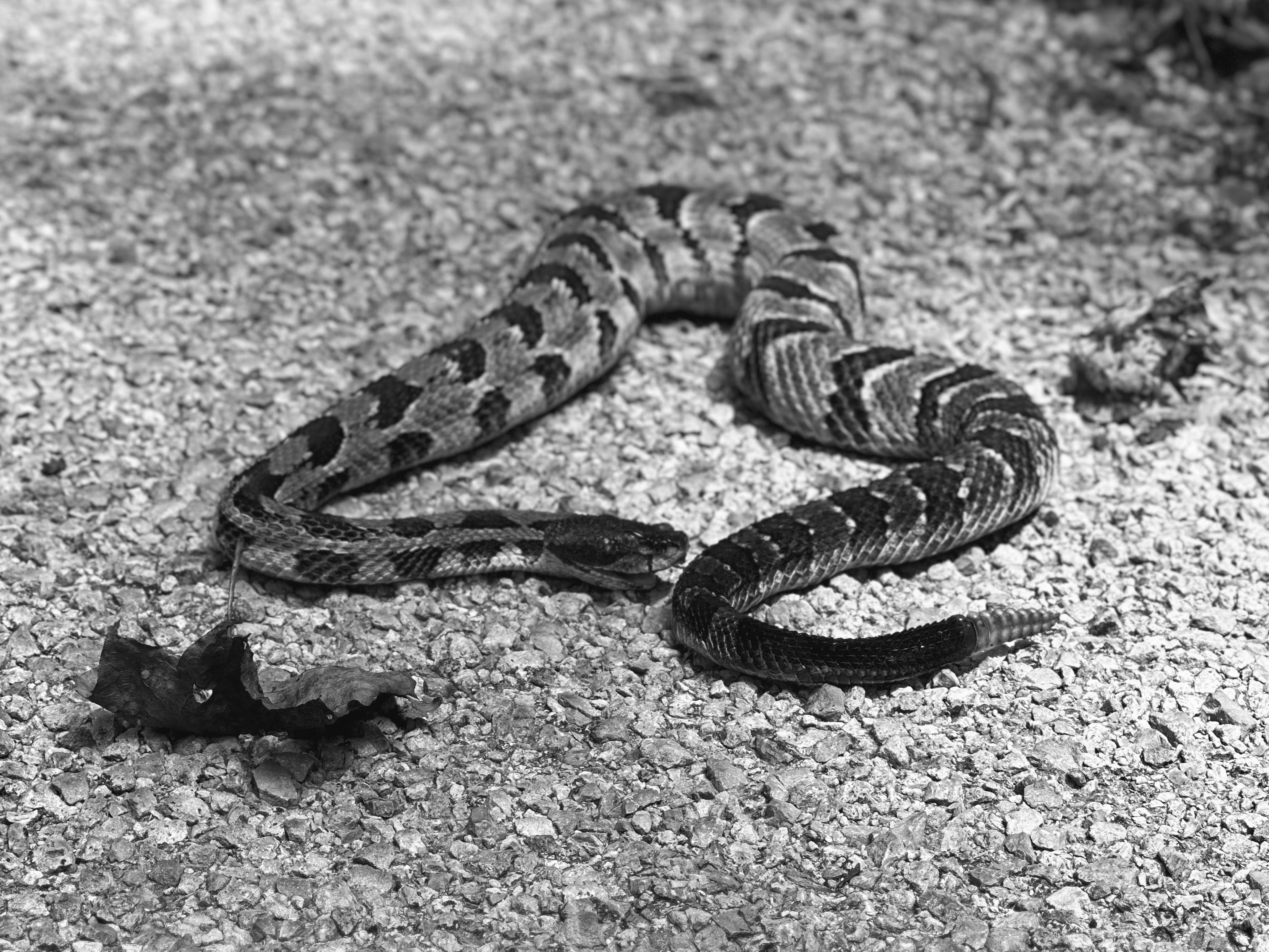
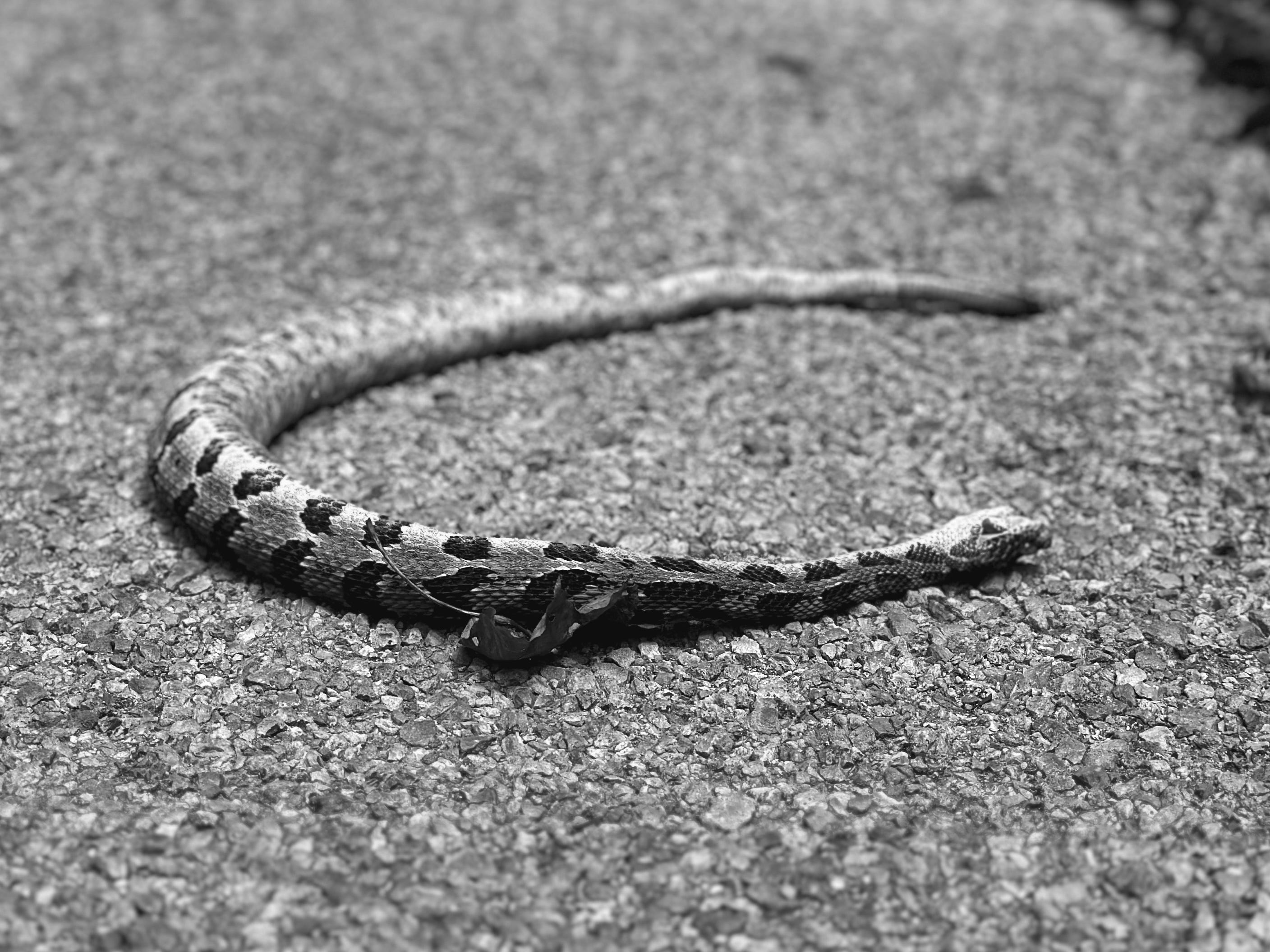
Last August, I was working on a (failed) photography project based off a Faulkner line I’d read. The goal was to capture the transitional period as summer gave way to early fall, to show the light as it lengthened. Driving home, Kinz and I saw two young men on four-wheelers staring at something on the ground. When they saw us, they sped off, kicking up gravel behind them. This section of remote road, surrounded by forest, used to be labeled on maps as Plummer Fork. But names change with a place. As I drove past, I saw what the young men had been looking at – two timber rattlesnakes. It was only after turning the car around and getting out for a closer look that I was able to piece together the scene I’d stumbled across. The young men had been running over the snakes with their four-wheelers. The largest, about four feet in length, was already dead. The other was dying as I approached it. I took out my phone and snapped two photos that captured the snake’s final moment. Showing compassion for a senseless death, I moved those snakes off the road into the thick cover of stiltgrass.