Beginning (On Restoration excerpt)

I met Tom Bridwell when I was twenty-four, not knowing the impact his life would have on mine. We were meeting at a mutual friend’s house for dinner and a discussion. Brian, the friend, owned a cabin with no electricity or running water on a remote ridge. Kinz and I wanted to live there, but first we needed approval from the cabin’s only neighbor.
This was after I sat, for a short stint, in an English class where Brian taught basic essay writing. Where I read Joyce for the first time. “Eveline” from Dubliners. After class, walking down the stairs of Massie Hall, Brian asked why I was here. I thought long enough to realize I didn’t have an answer. I found it in a newspaper the following day, sitting alone in my car in a Kroger parking lot. It was some synchronistic headline that read Follow The Music. So I dropped out of college and did exactly that. This path didn’t lead to the stage of the Taft Theatre but to the ridge instead. The music wasn’t a song of my own but rather the rhythmic refrain of the whip-poor-will.
The cabin was on an acre of land sandwiched between Tom’s twenty-seven and the Shawnee State Forest. I’d lived in the area all my twenty-four years but hadn’t been to the forest much. When I was a kid, we spent the day swimming at Turkey Creek Lake. I have vague memories of my brother getting chased by a Canadian goose he was trying to intimidate, and of a sunscreen bottle, lid opened, lying on a towel. Due to my desire to cool off in the murky water, the visual is of the bottle becoming smaller and smaller as I neared the water’s edge. The result was severe sunburn which raised blisters across my shoulders, leaving a scar I can still feel.
The 63,000-acre forest, 8,000 of which are designated as a wilderness area where no roads or motorized vehicles are permitted, spans Scioto and Adams County. Before the first piece of land was purchased by the state in 1922, this unglaciated area of Southern Ohio was quarried for building stone, which was transported on the Ohio River. Within the forest there are miles of hiking trails, nearly fifty in a continuous loop, which cross bridle trails and forest roads. All this secluded beauty was only a short drive from the apartment we were living in. Kinz and I would often drive out Road 6, which made for a scenic loop during peak colors. Wouldn’t it be nice to live out here, Kinz said once, neither of us realizing it would soon be a possibility.
We ran into Brian at the pub one night and asked him how things were at the cabin, unaware he’d moved to a cottage down the road. Empty, he replied. Kinz joked, if you ever want someone to live there, let us know. To our surprise he thought it’d be nice to have someone up there. While seemingly simple, this benevolent comment would shift the focus of our lives.
But this was October and winter was approaching quickly. What would a winter with no electricity be like? How much firewood is needed to keep a small cabin warm? I was having a hard time answering these questions and separating from the recording studio I’d pieced together in the apartment. No way to record meant no one would hear the songs.
We decided to wait and see how we felt about the move come spring. A few months later, I ran into Brian again at the pub. It was a Christmas party where most attendees got smashed and sang holiday tunes slightly off-key. I was already drunk when Brian sat on the stool next to me. I immediately expressed my concerns without him asking. He told me about logging on the Olympic Peninsula. Said he carried books in a waterproof footlocker. Books he ended up teaching at the university years later. I think he was trying to tell me things have a way of unfolding in their own time.
I shook Tom’s hand, rough and thick-nailed, and sat at the table. The cottage Brian purchased a year-and-a-half prior was only a mile from the driveway shared by the cabin and Tom’s house. Eggplant and fried vegetables with a spicy peanut sauce were plated in front of me. Kinz talked about the move while I listened and chewed. Tom asked about our plan for lighting. Anyone who has spent time living remotely will always ask about lighting first. I’ve since learned why. The rules of the driveway, wide enough for one vehicle only, were laid out. If we meet in the middle, whoever is going up must reverse. It’s the only way. But the chances of meeting are slim. Only once in fifteen years had it actually happened.
I listened to Tom and Brian discussing Moby Dick, some kind of overhauled analysis from a recent article. Tom offered it up and Brian laughed it out. I hadn’t read the book. I asked about David Foster Wallace, having read Infinite Jest a year prior, displaying my pride of punching above my weight during those years. They both liked it well enough. I didn’t like the boring one about the IRS, Tom admitted. Oh, The Pale King, Brian knew.
Outside, preparing to leave, Tom saw my car. It was a Scion XB I’d been driving for the previous five years, which looked more like a toy than a useable vehicle. Is this your only car, he asked, observing the low ground clearance. Yeah, I replied. You’re going to need a different one, he said, cigarette perched between his fingers. And he was right.
It wasn’t six months later, on a rainy October evening I decided to sell my car. I was confident, the kind of confident attached to inexperience, the car would work well enough for winter conditions. The driveway, with a steep drop-off to the drainage below, was challenging. But I’d been driving the car up and down for months, gaining as much speed as I could before hitting the slight right curve and powering my way to the top. That October evening, I’d forgotten about the bald tires and didn’t know the damage a steady rain could have on the driveway. It was soggy and slickened by colorful leaves that had recently fallen. I hit the curve at the usual full-speed and the small box car went sliding sideways, almost over the edge. In a panic, I grabbed the wheel and locked my elbows. The back end shifted wildly, but I made it up. By early November I’d sold the Scion and purchased an old 4Runner, which was capable but wasn’t without operator error.
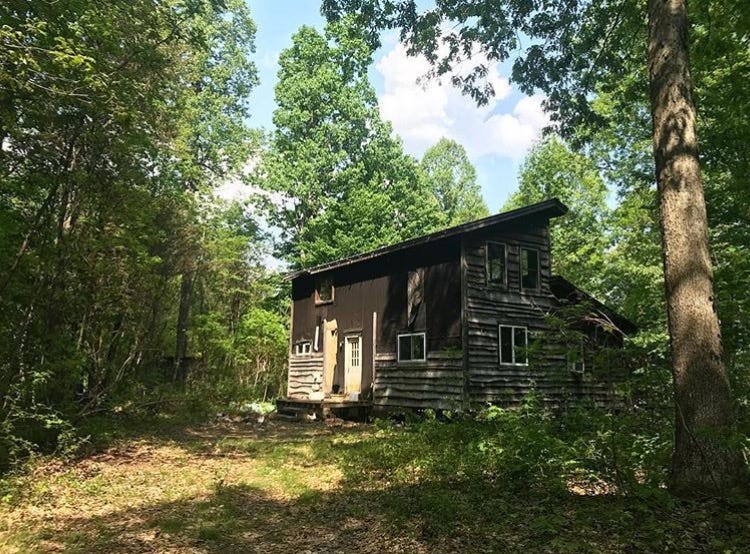
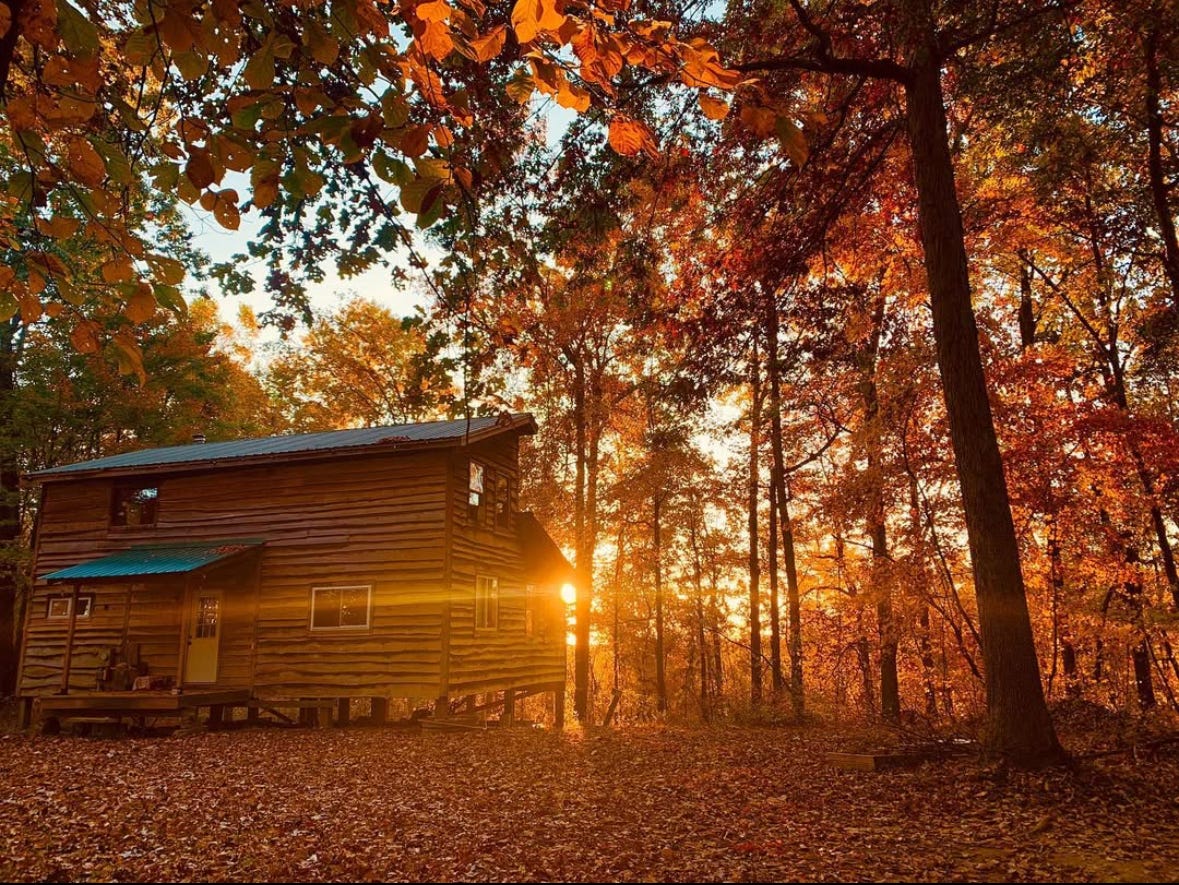
We arranged a day to meet with Brian at the cabin, but a late season snowstorm put it off. In a weekend system, fifteen inches of the stuff blew in and took two weeks to disappear. We met back at Brian’s and he drove us up the driveway in his truck. Once at the top, he reserved into a small clearing. Always park facing out, you just never know, he would advise later as we watched Tom do the same thing. The cabin had tall ceilings which made it feel larger than its footprint. The interior walls were covered with planed poplar boards milled a short drive away. I’d become very familiar with those walls, filling notebooks on observations from within them.
The cabin and Tom’s house were separated by a short walk. The ridge stretched out like a basking rattlesnake and between the two was the letterpress shop Brian had operated as Bloody Twin Press. Brian suggested we walk over to visit Tom and see his house. He might say he’s going to finish it, but he’s been saying that for fifteen years now, Brian told us, smiling as he said it.
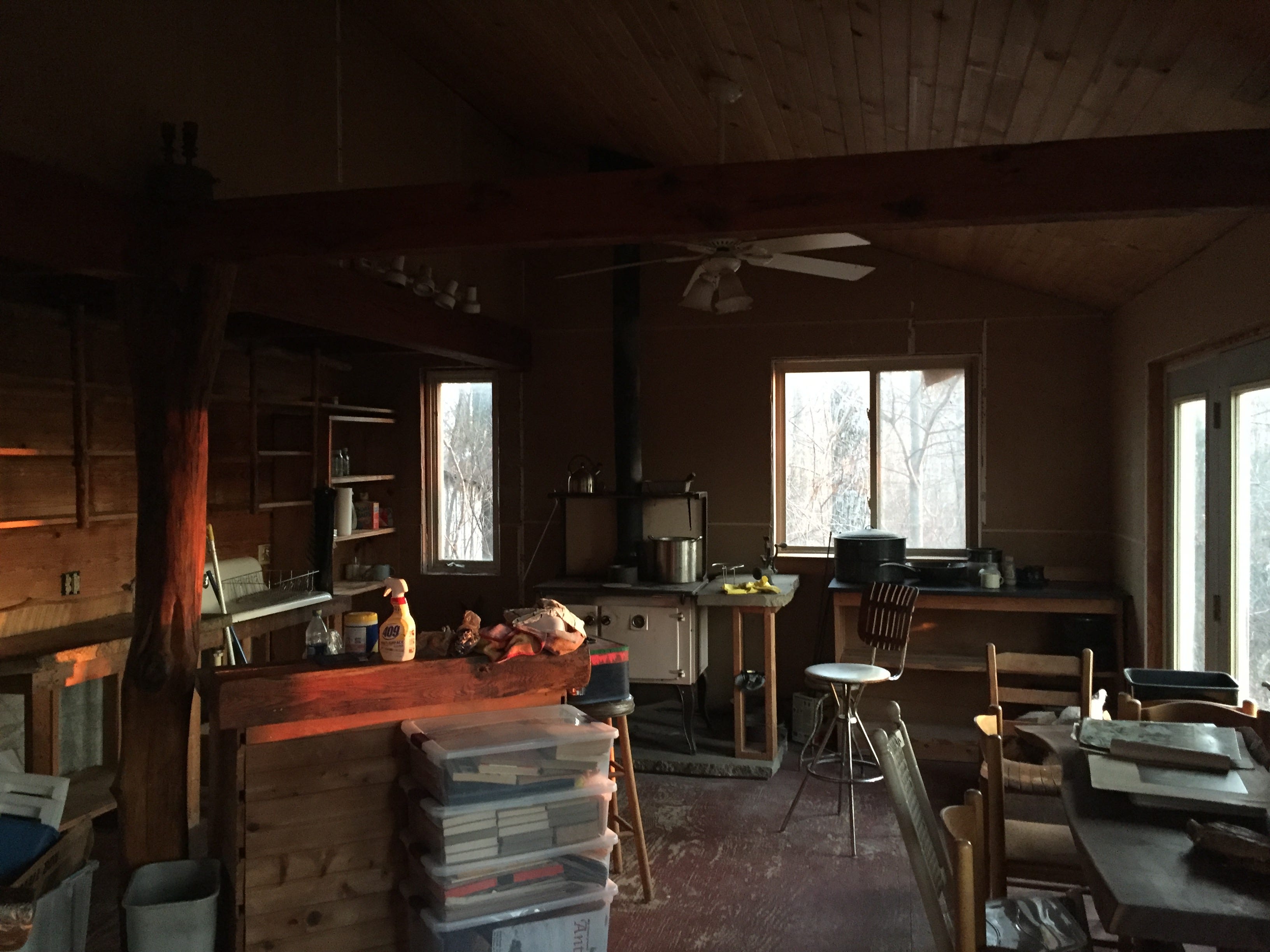
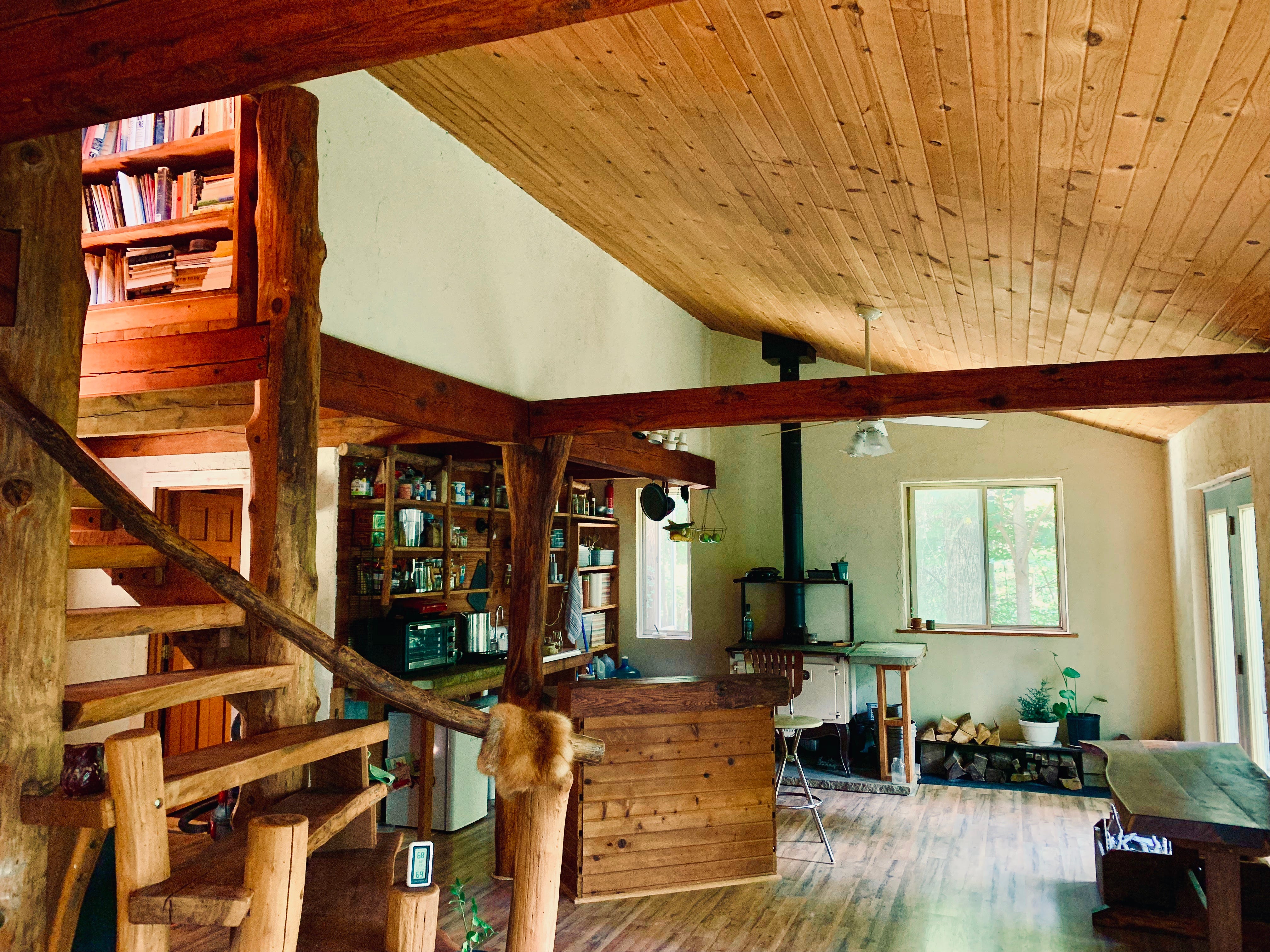
The trail opened to a two-story structure with two opposing roof pitches. The lower shed roof kicked out to the south, the upper to the north. The west side and only a quarter of the north side were covered in rough-cut poplar, weathered gray, with live edges running in whimsical lines. Where the siding wasn’t, aged tar paper covered the plywood sheathing. Inside, Tom showed us the staircase he built. Walnut slabs someone was considering using for firewood, which he purchased for seventy-five bucks mostly to save them. The stairs, notched into bead-blasted walnut posts, turned almost a full ninety in the first five treads. All with an electric chainsaw, Tom told me. The upper section of the stairs had a bookcase on each side, both without an empty space.
It’s these stairs I find myself looking at one June morning. Three years have passed since we moved to the ridge and I first saw this staircase. Tom died during the autumn of 2017. I mourned my neighbor by listening to the blues and reading Gravity’s Rainbow, a book he’d loaned me during one of the handful of visits I had with him. His daughters, who live on the opposite side of the country, were uncertain about the future of the property. Brian mentioned the house to me and Kinz one winter night at his place while working on a grant application to reboot Bloody Twin. It seemed the move would not only be helpful to the sisters but to us as well. We would still be on the ridge but with electricity. We emailed with the sisters and eventually met with them when they arrived in town the following spring for Tom’s memorial. I agreed to keep up with any necessary maintenance and to do the work on a series of repairs. Now, standing inside the house, I’m uncertain if I’m the correct person for the job. Not incapable of learning but my skillset is limited. Each problem as they arrive, I decide, climbing the stairs and placing the copy of Gravity’s Rainbow back on the shelf.